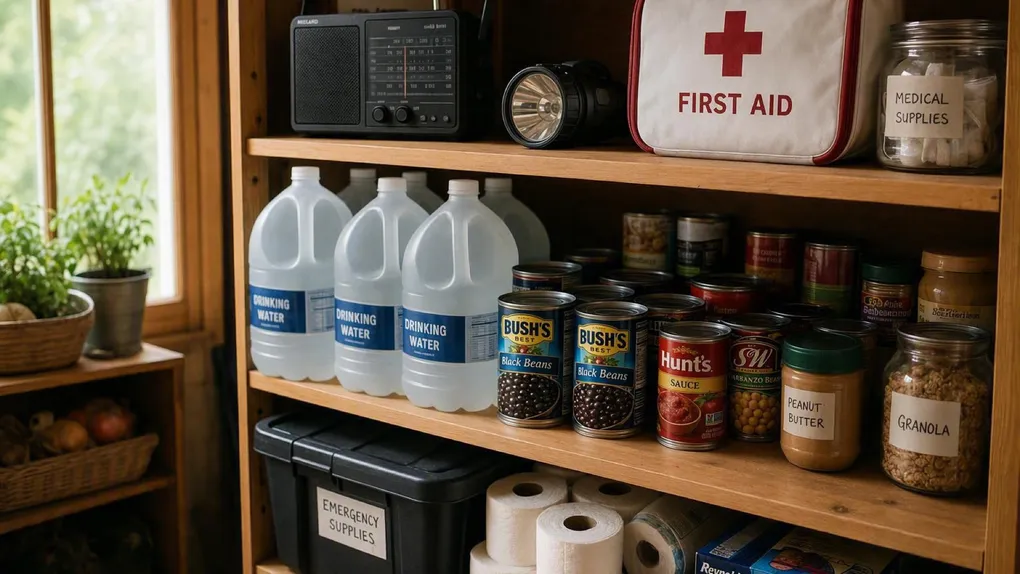
Prepping for anything: Know your risks, make a plan, take action
The fire chief who retired after forty years said the sentence that opens every serious preparedness conversation: “In the first seventy-two hours, there are only two kinds of households, the ones who are their own first responders and the ones who are waiting for help that cannot come.” His crews saw both, every storm. The waiting ones were not careless. They had just never been told that the cavalry has to triage a whole city before it reaches a single street.
Every U.S. state and territory is at risk of some kind of disaster. It is not a question of if something will happen, but when. And when it does, the first responders you are counting on may not be able to reach you right away, because they are helping everyone else in your community at the same time.
This is the uncomfortable truth at the heart of citizen preparedness: in the first hours and days of a disaster, you are your own first responder. The good news is that the framework for being ready is simple, proven, and free. FEMA’s “Are You Ready?” guide distills it into three steps: Know Your Risks, Make a Plan, and Take Action. This series walks you through all three, plus the recovery that comes after.
Disclaimer: The information provided in this article is for general informational and educational purposes only. It is not intended as, and should not be considered, professional, legal, insurance, or emergency-response advice. Always follow the instructions of local authorities and emergency officials during an active event.
The Six-Part Framework
Part 1: Know Your Risks
You cannot prepare for a hazard you do not know you face. Every community has a different threat profile: a coastal town worries about storm surge, a mountain town about wildfire, a plains town about tornadoes.
Caution: “It can’t happen here” is a gamble. Every state and territory is at risk of something. Learn the hazards specific to your home, and the basic protective actions that apply to all of them.
Read the full guide on Know Your Risks
Part 2: Make a Plan
When the power is out and cell towers are down, how will your family find each other? A plan answers that question before the disaster asks it.
Caution: The “we’ll figure it out” trap. Families that plan ahead stay safe, limit damage, and recover faster. Build a family communication plan, an evacuation plan, and a shelter plan, and practice them.
Read the full guide on Make a Plan
Part 3: Build Your Emergency Supply Kit
A kit is your insurance against the first 72 hours, when stores are closed and help is stretched thin.
Caution: A kit in the garage is a kit you can’t reach. Store supplies at home, at work, and in your vehicle, and refresh them every six months.
Read the full guide on Build Your Emergency Supply Kit
Part 4: Take Action
Knowing is not doing. Insurance, documentation, and mitigation are the actions that turn a plan into protection.
Caution: The coverage gap is catastrophic. Standard homeowners policies do not cover floods or earthquakes. Understand your policy, document your property, and protect it before the disaster.
Read the full guide on Take Action
Part 5: Alerts and Warnings
A warning only helps if you receive it and know what it means. The difference between a watch and a warning can be the difference between life and death.
Caution: A silent phone is a missed warning. Sign up for every alert system available in your area, and make sure your whole household gets them.
Read the full guide on Alerts and Warnings
Part 6: Recovering from Disaster
The disaster does not end when the storm passes. Re-entry, insurance claims, and fraud protection are the final phase of preparedness.
Caution: The “mold clock” and the scammer are both ticking. Know how to re-enter safely, file a claim, and spot disaster fraud.
Read the full guide on Recovering from Disaster
The Master Checklist
When the siren sounds, you will not remember a ten-step plan. The checklist consolidates this entire series into a printable, phase-by-phase protocol.
Read the full guide on The Master Checklist
Next Steps
- Start with Part 1 if you have never named your hazards, because everything in this framework hangs off knowing what your community actually faces.
- Jump straight to Part 3: Build your emergency supply kit if the supplies are the gap, since the first 72 hours are the window this whole series defends.
- Print the Master Checklist and put it on the refrigerator, because the plan that lives on paper survives the phone that does not.
Adapted from FEMA Ready.gov “Are You Ready?” (public domain).