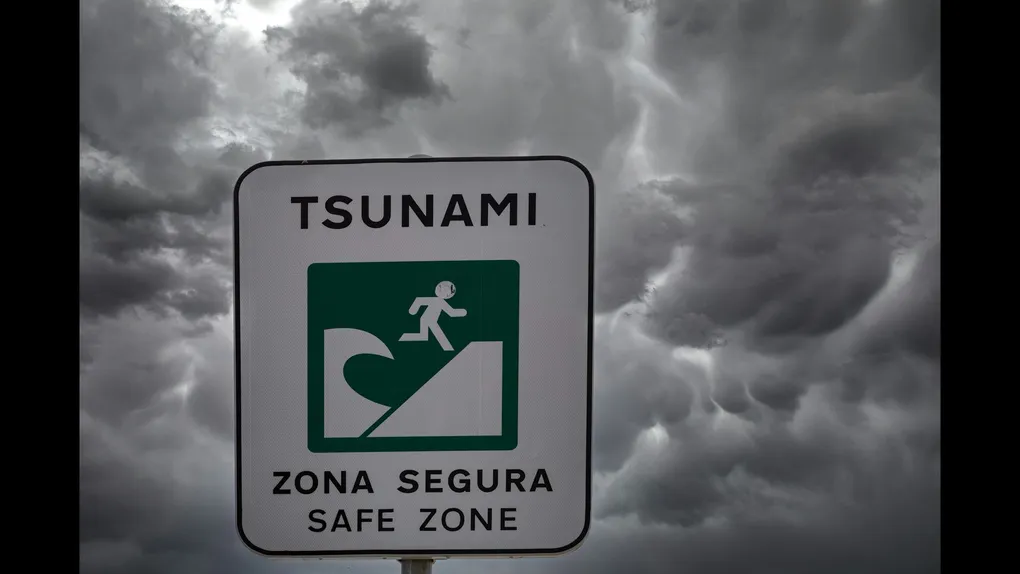
Prepping for a tsunami (Part 3): The evacuation
The survivor who watched the wave take the coastal highway described the traffic from above: two lanes of cars, brake lights all the way to the horizon, moving at walking speed, with the water arriving behind them at 20 miles an hour. The people who lived through it were the ones who had stepped out of their cars and started walking. A car in gridlock is a coffin. Feet can move between lanes, take the stair street, cut through the church parking lot, and climb. The wave does not care what you planned to drive. It cares how fast you can move your body uphill.
When the warning comes, you have minutes. You cannot drive, roads will be gridlocked. You must evacuate on foot, to high ground, and you must know the route before the ground starts shaking.
Caution: The “Car” trap. People who try to drive to safety die in traffic jams. Tsunami evacuation is a foot race to high ground. Pre-map your route, and drill it until you can walk it in the dark.
Disclaimer: The information provided in this article is for general informational and educational purposes only. It is not intended as, and should not be considered, professional or emergency-response advice. Always follow the instructions of local authorities and tsunami warning centers.
The Readiness Audit
Do you know your evacuation route to high ground?
- Green: You’ve mapped your route, walked it, and timed it. You know exactly how long it takes to reach high ground on foot.
- Yellow: You have a vague idea of where high ground is, but you’ve never walked the route.
- Red: You’d plan to drive, and you’ve never thought about where you’d go.
If you are Yellow or Red, execute Phase 1 immediately.
Phase 1: The Foot Race (Why You Don’t Drive)
Goal: Understand why evacuation is on foot.
The single most common fatal mistake in a tsunami is trying to drive to safety.
- The gridlock: when a warning is issued, everyone tries to drive at once. Roads become parking lots within minutes.
- The speed: a tsunami can travel at 20-30 mph in shallow water, faster than you can run, and faster than gridlocked traffic.
- The solution: evacuate on foot. You can move through traffic, take shortcuts, and reach high ground faster than any car.
The Takeaway: In a tsunami, your feet are faster than your car. Evacuate on foot.
Phase 2: Mapping the Route
Goal: Pre-map your route to high ground before you need it.
- The target: get at least 100 feet above sea level or 2 miles inland. If you can’t reach that, go as high and as far as you can, every foot of elevation helps.
- The map: use your local tsunami evacuation map to identify the nearest high ground and the fastest route to it.
- The walk: walk the route once, in daylight, and time it. Then walk it again, imagining it’s dark and the ground is shaking.
- The alternative: identify a second route in case the first is blocked by debris or crowds.
The Takeaway: A route you’ve walked is a route you can run. A route you’ve only imagined is a guess.
Phase 3: The Go-Bag
Goal: Keep a small go-bag ready by the door.
- The contents: water, a flashlight, a whistle, sturdy shoes, and a charged phone. Keep it light, you’re running, not camping.
- The placement: by the door, where you can grab it without thinking.
- The rule: if grabbing the bag costs you even 30 seconds, leave it. Your life is worth more than the bag.
The Takeaway: A go-bag is a convenience, not a requirement. Never let it slow your evacuation.
Phase 4: The Drill
Goal: Make the evacuation muscle memory.
- The family drill: practice the full evacuation, from “the ground is shaking” to reaching high ground, at least once a season.
- The timing: time it. Know how long it takes, and where the bottlenecks are.
- The night drill: practice once in the dark. A tsunami can come at night, and the route looks different in the dark.
The Takeaway: In a crisis, you don’t rise to the occasion, you fall to your level of training. Drill until the route is automatic.
The Essential Kit Checklist
- The map: obtain your local tsunami evacuation map.
- The route: identify and walk your primary and backup routes to high ground.
- The timing: time your evacuation on foot.
- The go-bag: pack a small go-bag and keep it by the door.
- The drill: run the family evacuation drill, including once at night.
Scenario Planner (Contingencies)
“The roads are gridlocked and I’m stuck in my car.” The trap: staying in the car, hoping traffic clears. The fix: abandon the car and run. A car in gridlock is a coffin. Your feet can move through traffic, your car cannot.
“I don’t know where high ground is.” The trap: freezing because you don’t have a plan. The fix: go up. Any significant elevation is better than sea level. Head inland and uphill, and keep going until you’re at least 100 feet up or 2 miles inland. In the moment, “up and inland” is a plan.
Next Steps
- Walk your evacuation route this weekend and time it, then walk it once more after dark, because the route you have only imagined in daylight is a guess.
- Pack the door go-bag tonight: water, flashlight, whistle, sturdy shoes, charged phone, and resolve that it never slows you down.
- Read Part 4: Vertical evacuation next, for the last-resort strategy when the water is already coming and high ground is out of reach.
Originally adapted from public NOAA tsunami guidance (public domain).