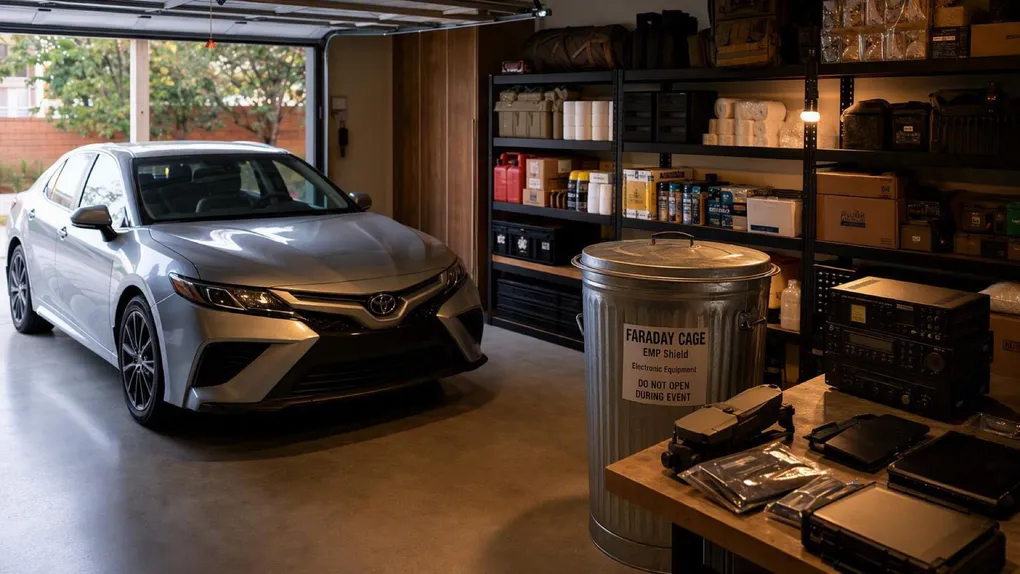
Prepping for a solar flare (Part 2): The myth of the fried car
We have all seen the scene in the apocalypse movie: a flash of light appears in the sky, and instantly every vehicle on the highway rolls to a stop. The hero turns the key: click, click, nothing. It makes for great cinema, but it is terrible physics.
This specific fear is the single biggest distraction in solar preparedness. People spend thousands of dollars trying to “EMP-proof” their garage with tinfoil while ignoring the actual threat. The confusion stems from mixing up two very different beasts: a CME (Coronal Mass Ejection) and an EMP (Electromagnetic Pulse). If you prepare for a movie script, you will fail the reality test. Physics dictates that your car will likely start just fine during a solar storm. The problem isn’t the vehicle, it’s the world around it.
Disclaimer: The information provided in this article is for general informational and educational purposes only. It is not intended as, and should not be considered, legal, medical, or engineering advice. Space weather is unpredictable. Always follow alerts from NOAA’s Space Weather Prediction Center.
The Readiness Audit
If a massive solar flare hit Earth right now, would you be walking or driving?
- Green: You understand the difference between an E1 (fast) and E3 (slow) wave. You know your car’s wiring is too short to couple with a solar flare. You keep your gas tank above half-full at all times.
- Yellow: You are terrified your car will die, but you have no backup fuel stored. You rely on GPS for navigation.
- Red: You believe a solar storm will fry your battery instantly. You are planning to wrap your ECU in aluminum foil.
If you are Yellow or Red, execute Phase 1.
Phase 1: The Physics of the Pulse (E1 vs. E3)
To understand why your car is safe from the sun, you have to understand the wave.
The EMP (The Sniper)
- The source: A high-altitude nuclear detonation.
- The wave: This creates an E1 pulse, a nanosecond-fast, high-frequency shock to electronics.
- The threat: It is fast enough to slip past surge protectors and fry microchips (like your car’s Engine Control Unit). This is the “movie” scenario.
The CME (The Tsunami)
- The source: The sun ejecting plasma (a solar storm).
- The wave: This creates an E3 pulse, a low-frequency, long-duration surge.
- The threat: E3 waves need a long conductor to build up energy, conductors that are hundreds of miles long.
- The reality: Earth’s power grid is a giant antenna that catches this energy (which is why transformers blow). Your car is barely 15 feet long. It is physically too small to “catch” enough energy from a CME to melt the wires.
The bottom line: A solar storm attacks the grid, not the garage.
The Takeaway: The E1/E3 distinction is the whole game. E1 is fast and targets microchips, E3 is slow and targets long wires. Your car contains short wires and chips, which puts it on the wrong end of both threats during a solar storm.
Phase 2: The Real Vehicle Threat (Logistics)
Just because your car starts doesn’t mean you are mobile. A running car in a grid-down world is a ticking clock.
The Pump Trap
- The trap: “I’ll just fill up when the alert comes.”
- The reality: Gas pumps run on electricity. When the CME hits the grid and the transformers blow, the pumps stop.
- The fix: The “half-tank” rule. Never let your vehicle drop below half a tank. That “half” is your emergency reserve.
- Tactical tip: If you have a garage (or better yet, a shed not connected to your house), store stabilized fuel in metal jerry cans (Wavian style). Plastic degrades, metal lasts.
The Navigation Blackout
- The trap: Reliance on Google Maps or Waze.
- The reality: A massive solar event disrupts the ionosphere, which can scramble or block GPS signals. Even if the satellites survive, the cell towers relaying the map data will be offline.
- The fix: The analog backup. You need a physical road map in your glovebox. Download “offline maps” on your phone as a backup, but paper does not require a battery. Map reading is a dying art, so teach your kids.
The Takeaway: The car survives the storm but not the supply chain. Fuel and navigation are the two systems that actually strand you, and both have cheap, analog solutions: the half-tank rule and the paper map.
Phase 3: The EMP Contradiction (If It Is Nuclear)
Even if we shift gears to a nuclear EMP (the E1 wave), the “fried car” theory is shaky.
The Testing Data
- The myth: All modern cars will stop instantly.
- The data: The EMP Commission tested around 50 different automobiles manufactured between 1987 and 2002, blasting running cars with massive E1 pulses.
- The result: Most cars did not stop. Of the ones that did stall, most restarted immediately by turning the key off and on again.
- The why: Cars are metal boxes. They act as partial Faraday cages. The sensitive electronics are buried deep inside the engine block (more metal).
The “Spare Brain” Protocol
- The fix: If you are truly paranoid about an E1 event, don’t wrap the whole car in foil. Buy a spare ECU (Engine Control Unit) and a spare alternator.
- Storage: Keep these spare parts in a Faraday bag in your trunk. If the pulse kills your car, you swap the brain, and you drive away.
The Takeaway: Even in the worst-case nuclear scenario, the testing data says most cars keep running and most stalled ones restart. The prepared answer is a spare ECU in a Faraday bag, not aluminum foil art projects on your bumper.
The Essential Kit Checklist
- The Paper Map: A Rand McNally or state gazetteer in the seat pocket.
- The Fuel Reserve: A 5-gallon metal jerry can (filled and stabilized) if you have safe storage space.
- The Spare Fuses: A complete box of fuses. Sometimes a pulse just blows a fuse, not the computer.
- The Faraday Bag: A small RF-shielded bag for your phone and handheld radio (which are vulnerable, unlike the car).
Scenario Planner (Contingencies)
“The car started, but now I’m stuck in gridlock.” The trap: traffic lights are out, every intersection is a four-way stop, and panic sets in. The fix: the “alternate route” audit. Do not take the highway. In a grid-down scenario, highways become parking lots. Map the backroads and “scenic routes” now.
“My car actually did stall.” The trap: assuming the car is dead forever. The fix: the hard reset. Disconnect the battery terminals. Touch them together (to drain residual capacitors). Wait 5 minutes. Reconnect. This “reboots” the confused electronics. Often, that is all it takes.
Previous: Read Part 1: The Carrington Event to understand the anatomy of a solar storm and why the grid is the target.