Prepping for a solar flare (Part 1): The Carrington Event
The “Carrington Event” of 1859 wasn’t a freak accident, it was a natural cycle. NASA estimates a roughly 12% chance per decade of a similar event hitting Earth. Fear comes from the unknown. By understanding the specific mechanics of a Coronal Mass Ejection (CME), how it travels, how it hits Earth, and specifically what it breaks, you stop visualizing a Hollywood apocalypse and start seeing an engineering challenge. Engineering challenges have solutions.
Disclaimer: The information provided in this article is for general informational and educational purposes only. It is not intended as, and should not be considered, legal, medical, or engineering advice. Space weather is unpredictable. Always follow alerts from NOAA’s Space Weather Prediction Center.
The Readiness Audit
Do you know the difference between a Solar Flare and a CME?
- Green: You know that we get 15 to 72 hours of warning before a CME hits, and you subscribe to NOAA Space Weather alerts.
- Yellow: You’ve heard of “solar storms” but think they might fry your phone in your pocket.
- Red: You think a CME is the same thing as a nuclear EMP and plan to hide in a bunker the moment the sun looks bright.
If you are Yellow or Red, let’s clear up the confusion.
Phase 1: The Anatomy of a Solar Sneeze
Think of the sun not as a lightbulb, but as a boiling pot of magnetic soup.
The Flare (The Flash)
- What it is: A sudden burst of radiation (X-rays and UV light) from the sun’s surface.
- Travel time: Speed of light. 8 minutes.
- The impact: It hits Earth’s upper atmosphere and disrupts radio and GPS: static, signal loss, and navigation errors.
- The takeaway: If your GPS goes haywire or HAM radio bands go silent, that is the doorbell ringing. The storm might be coming.
The CME (The Cloud)
- What it is: A Coronal Mass Ejection. The sun literally burps out a billion tons of plasma (charged particles) and its own magnetic field.
- Travel time: 15 to 72 hours. This is slower than light.
- The impact: This cloud tears through space. If Earth is in the crosshairs, the cloud slams into our planet’s magnetic shield (the magnetosphere).
- The result: The collision shakes Earth’s magnetic field violently. This shaking is what causes the damage.
The Takeaway: The flare is the doorbell and the CME is the guest. Light arrives in 8 minutes, damage arrives in days, and that gap is your entire preparation window. Treat every flare alert as an early warning system, not a false alarm.
Phase 2: The History Lesson (1859 Carrington Event)
In September 1859, a massive CME hit Earth, named after Richard Carrington, the astronomer who saw the flare.
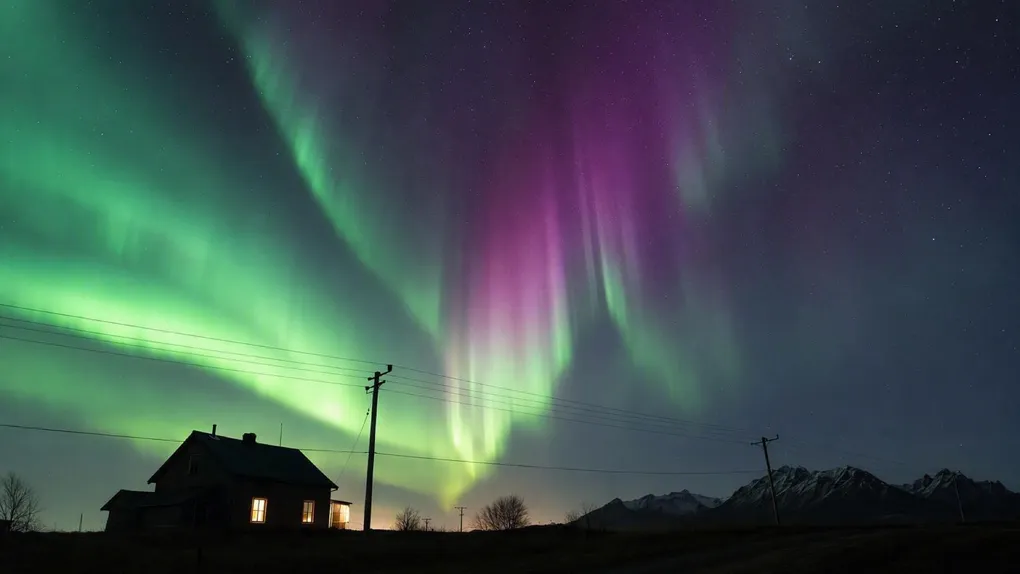
- Auroras: The Northern Lights were so bright that gold miners in the Rocky Mountains woke up at 1:00 AM and started making breakfast, thinking it was dawn. The lights were seen as far south as Cuba and Hawaii.
- The tech failure: In 1859, our “grid” was the telegraph system. Operators reported sparks flying from their tapping keys, and some telegraph papers caught fire.
- The kicker: Some operators found they could unplug the batteries and still send messages. The air was so charged with electricity that the atmosphere itself powered the network.
The Takeaway: In 1859, a fried telegraph meant a delayed letter. Today, that same energy would flow into our massive, interconnected power grid. We traded copper telegraph wires for high-voltage transmission lines that span continents. We built a much bigger antenna for the sun to zap.
Phase 3: The Mechanism of Destruction (Induction)
This is the part people get wrong. A CME is not a nuclear EMP. It does not “fry everything with a microchip.”
The “Long Wire” Effect
- The science: When a magnetic field moves (like the shaking of Earth’s shield), it induces an electrical current in any long conductor.
- The conductor: The longer the wire, the more current builds up.
- Your phone: 4 inches of wire. Negligible current. Safe.
- Your car: 15 feet of wire. Minimal current. Likely safe.
- The power grid: Thousands of miles of continuous copper wire. Massive current.
The Transformer Bottleneck
The induced current (called GIC, Geomagnetically Induced Current) rushes through the power lines looking for a path to ground. It finds it at the high-voltage transformers, those giant metal boxes at substations.
- The failure: The extra current overheats the transformer cores. They melt, burn, and fail.
- The nightmare: These transformers are not “off the shelf” parts. They are custom-built, weigh 400 tons, and take 12 to 18 months to manufacture. If we lose 300 of them at once, the lights don’t come back on for years.
The Takeaway: Length is destiny. Induction scales with conductor length, which is why a device in your pocket survives an event that kills the grid around it. The transformer bottleneck is the single fact that turns a space weather story into a months-long blackout scenario.
Phase 4: The Scale (NOAA G-Scale)
NOAA ranks these storms just like hurricanes.
- G1 to G3 (Minor to Strong): Happens frequently. Northern lights visible in northern states. Minor grid fluctuations. No action needed.
- G4 (Severe): Voltage control problems. Satellite navigation issues. We see these once or twice per solar cycle (11 years).
- G5 (Extreme, Carrington Class): This is the “SHTF” event. Widespread voltage control problems, grid collapse potential, transformers overheating, satellite destruction.
The Essential Kit Checklist
- The Alert: Subscribe to NOAA Space Weather Prediction Center email alerts (swpc.noaa.gov).
- The App: Download an Aurora Forecast app (like “Aurora”), it’s often the first warning regular people see.
- The Knowledge: Bookmark the “Space Weather Enthusiasts Dashboard.”
- The Drill: Have a family conversation: “If the internet and power go out worldwide tomorrow, where do we meet?”
Scenario Planner (Contingencies)
“I saw the Northern Lights in Florida, is it too late?” The trap: treating the aurora as just a pretty show. The fix: immediate action. If you see auroras that far south, a G5 storm is already happening. Initiate your “Power Down” protocol immediately. You might have minutes before the grid destabilizes.
“The news says a flare hit, but nothing happened.” The trap: “cry wolf” syndrome. The fix: wait for the CME. The flare (light) hits in 8 minutes. The CME (the damage) takes days. Use that gap to top off water, charge batteries, and prepare to go off-grid.
Next: Read Part 2: The Myth of the Fried Car to learn why your vehicle survives and what actually stops you on the road.