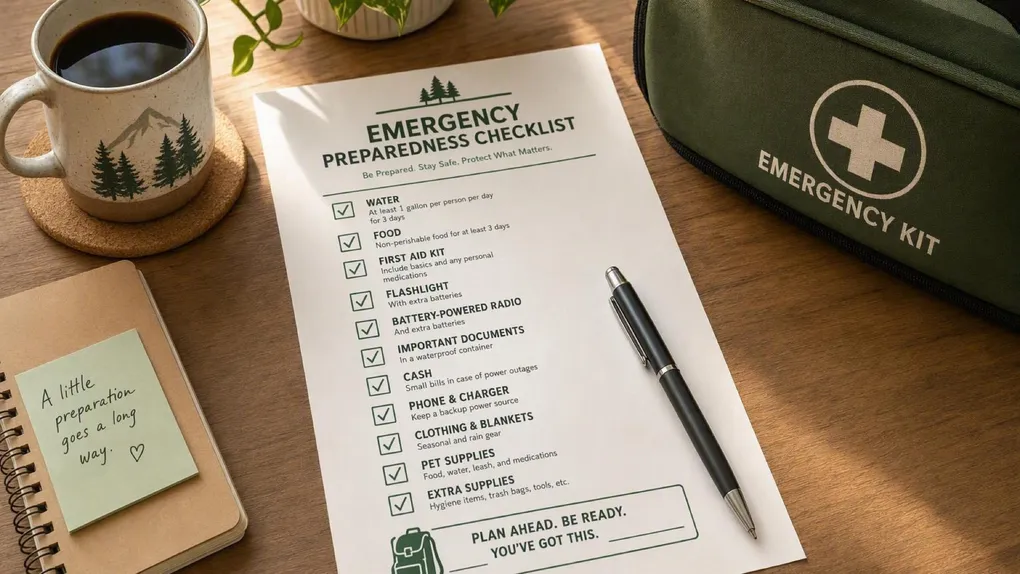
The CERT Readiness Checklist
Nine units of training are worthless as a memory and priceless as a page. Unit 9 of the CERT Basic Training course closes with a review and a disaster simulation, and the review’s lesson is the one this checklist borrows: under stress you fall back on what you rehearsed, not what you read once. Print this page, walk it with your team, and re-run it every six months.
Disclaimer: The information provided in this article is for general informational and educational purposes only. It is not medical, legal, or emergency-response advice. CERT skills require hands-on training through your local program. In a real emergency, call 911 first.
Next Steps
- Re-run the Readiness Audit. Scroll back to the top, answer the three questions honestly, and close whichever gap they reveal before you close this tab.
- Print the checklist. The kit list above only works if it exists when the power is out, so paper beats apps here.
- Fold it into the family plan. A prepared household beats prepared person, so put these steps in front of everyone who shares your roof.
Mission 1: Household and kit readiness (Unit 1)
- Water stored: at least 1 gallon per person per day, 3-day minimum (3 quarts drinking, 1 quart food prep and sanitation).
- Water purification method known: rolling boil for 1 minute or purification tablets.
- Wrench and pliers staged at gas and water shutoffs, practiced in the dark.
- Small ABC-type fire extinguisher in the kitchen, tested.
- Whistle, signal flare, landline phone (if copper service), and local maps in the kit.
- Sanitation supplies: chlorine bleach, disinfectant, garbage bags, towelettes.
- Safe room versus shelter-in-place decision made for each household hazard.
- Family plan written: evacuation routes, meeting places, out-of-area contact.
Mission 2: Team organization (Unit 2)
- Neighborhood staging area identified and walked.
- Reporting chain known: volunteers report to the Team Leader, the TL reports to the first fire or law enforcement official on scene.
- CERT Damage Assessment Forms printed and stored with the kit.
- Five ICS functions (Operations, Intelligence/Investigations, Planning, Logistics, Finance/Administration) understood by at least two neighbors.
- Backup communications (ham radio or similar) identified and tested.
Mission 3: Medical readiness (Units 3 and 4)
- Pressure dressings, bandages, nitrile gloves, and a commercial tourniquet in the kit.
- Four bleeding stages memorized: under 15 percent looks normal, 15 to 30 percent agitated, 30 to 40 percent confused (Stage 3), above 40 percent irreversible.
- Jaw-thrust maneuver learned from a certified first aid course.
- DCAP-BTLS assessment card printed (Deformities, Contusions, Abrasions, Punctures, Burns, Tenderness, Lacerations, Swelling).
- Treatment area pre-plan: location, separated survivor areas, separated morgue area.
- Consent rules known: conscious patients are asked, unconscious patients fall under implied consent, parents consent for children.
Mission 4: Psychology and fire safety (Units 5 and 6)
- Team briefing habit established: expected scenes and expected emotional responses covered before every incident.
- Rotation plan written: high-stress to low-stress jobs, breaks away from the incident area.
- Post-shift debrief held after every significant operation.
- Personal baseline maintained: sleep, exercise, balanced diet, connection.
- Fire classes known: A (ordinary combustibles), B (flammable liquids, vapor burns), C (energized electrical).
- P.A.S.S. drilled: Pull and test, Aim at the base, Squeeze, Sweep.
- Suppression rules internalized: buddy system, backup team, two ways out, look at the door.
- Natural gas and CO detectors on every level, tested monthly, near gas appliances.
Mission 5: Rescue and awareness (Units 7 and 8)
- Nine-step size-up card in the go-kit, with step 5 as the gate: can we attempt this safely? If no, do not attempt.
- Cribbing lumber (4x4 sections) and a pry lever staged.
- Six-sides search rule known: every interior space has six sides including floor and ceiling.
- Survivor removal options known: self-removal or assist first, then lifts and drags.
- Eight signs of terrorism known: surveillance, elicitation, tests of security, funding, acquiring supplies, impersonation, rehearsal and dry runs, deployment.
- FBI SAR tip line (tips.fbi.gov) and local law enforcement numbers saved in every phone.
- Shelter room pre-planned: duct tape, plastic sheeting, battery or crank radio for EAS broadcasts.
- Run, Hide, Fight family conversation held.
Final step: The simulation
- Walk the whole checklist with your team in one session, twice a year.
- Run a 30-minute disaster simulation: one hazard, one staging area, one Damage Assessment Form completed for real.
- Update the checklist with what the simulation exposed, because Unit 9’s lesson is that the drill finds the gaps.
Scenario planner (contingencies)
“We trained once, years ago.” The trap: skills decay faster than certificates expire. The fix: the twice-yearly checklist walk plus one simulation per year keeps the nine units load-bearing.
“Nobody on the street wants to train.” The trap: waiting for consensus before building capability. The fix: the CERT model starts with individuals who can act safely alone, then team up. Be the first trained household and let the simulation invite the neighbors.