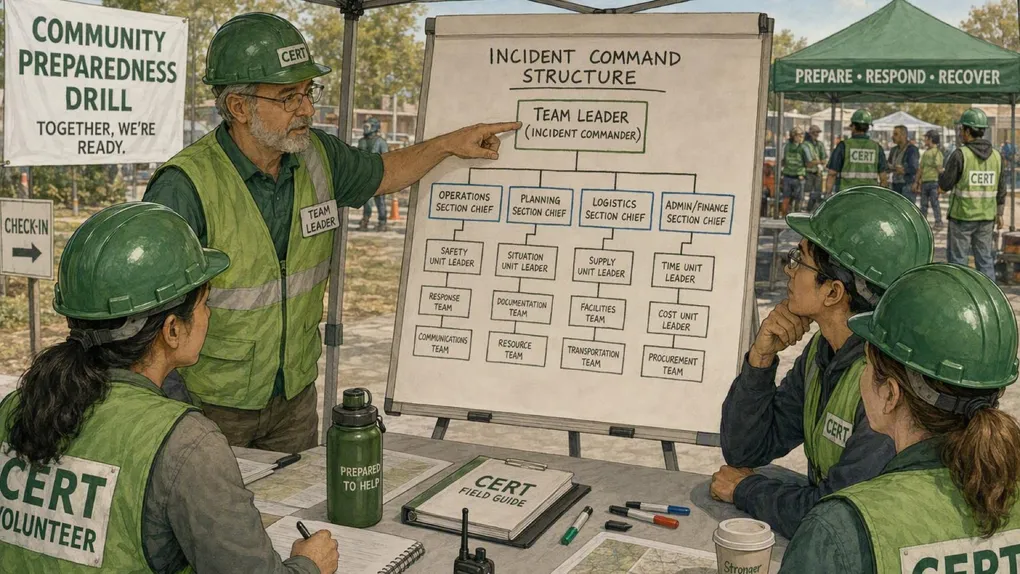
CERT Organization and the Chain of Command
Spontaneous volunteers are a disaster resource and a disaster liability at the same time. The difference is structure. CERT Unit 2 teaches the Incident Command System (ICS), the same management system professional responders use, so that volunteers feed into the response instead of adding a second, uncoordinated one to it. This post distills Unit 2’s structure and its nine-step size-up.
Disclaimer: The information provided in this article is for general informational and educational purposes only. It is not intended as, and should not be considered, professional advice. CERT roles require training through your local program.
The Readiness Audit
If five neighbors showed up to help after a collapse, who would direct them?
- Green: Your area has a staging location, a known reporting chain, and a damage assessment form ready.
- Yellow: Neighbors would self-organize informally.
- Red: Everyone would freelance, including you.
If you are Yellow or Red, execute Phase 1 immediately.
Phase 1: The Incident Command Structure
Goal: Learn the spine of the response.
CERT organization is based on the Incident Command System, a proven management system used by emergency responders. When a Team Leader (TL) determines the objective and sets priorities, he or she may assign personnel to the ICS Command Functions: an Operations Section Chief, an Intelligence/Investigations Section Chief, a Planning Section Chief, a Logistics Section Chief, and a Finance/Administration Section Chief. The Planning Section develops the team’s action plan, develops alternative strategies, and provides documentation services. Logistics provides communications, food and medical support to volunteers, and manages supplies and facilities, making sure adequate resources exist for the incident objectives.
The Takeaway: Five section chiefs exist because five different jobs choke a response when one person tries to do them all. The structure is not bureaucracy, it is how effort gets aimed.
Phase 2: The Chain of Command
Goal: Know who reports to whom.
Through an effective ICS, all CERT volunteers report through a chain of command to the TL, and the TL reports to the first fire or law enforcement official at their location and takes direction from that person until otherwise directed. That single rule is what turns citizens into an asset: professional responders get a coordinated team with one voice instead of twenty scattered individuals.
The Takeaway: The chain of command exists to make volunteers predictable to professionals. Reporting up, taking direction, and feeding information through the TL is the whole discipline.
Phase 3: Size-Up and the Standard Documents
Goal: Learn the assessment that drives everything.
Unit 2 teaches the 9-step On-Scene size-up process, the structured assessment that happens before any action. Its output feeds the standard CERT documents, most importantly the Damage Assessment Form: as volunteers travel through the area to the CERT staging location, they complete the form, which provides a summary of overall hazards in selected areas. The form goes to the CERT TL, who assembles teams and uses the information for prioritizing and formulating activities.
The Takeaway: Size-up before action, and write it down. The Damage Assessment Form is how a neighborhood’s scattered observations become one prioritized picture that professionals can act on.
The Essential Kit Checklist
- The Chain: Every neighbor volunteer knows the reporting rule: report to the TL, TL reports to the first fire or law enforcement official.
- The Forms: CERT Damage Assessment Forms printed and stored with your emergency supplies.
- The Sections: The five ICS functions (Operations, Intelligence/Investigations, Planning, Logistics, Finance/Administration) understood well enough to fill one.
- The Staging Link: The path from your street to the staging area walked and timed in advance.
- The Radio: Ham or similar backup communication identified for coordination when cells fail.
Scenario Planner (Contingencies)
“ICS is for professionals, we are just volunteers.” The trap: freelancing volunteers get in the way of the response and can become casualties themselves. The fix: ICS is precisely the system that makes volunteers usable. One TL, one chain, one reporting voice.
“Someone has to take charge immediately.” The trap: the loudest neighbor is not always the best commander. The fix: the CERT rule is already written, the first volunteer to arrive at staging becomes the initial Team Leader and passes leadership as more experienced people arrive. Structure beats improvisation.
Next Steps
- Re-run the Readiness Audit. Scroll back to the top, answer the three questions honestly, and close whichever gap they reveal before you close this tab.
- Print the checklist. The kit list above only works if it exists when the power is out, so paper beats apps here.
- Fold it into the family plan. A prepared household beats prepared person, so put these steps in front of everyone who shares your roof.
Next: Read Disaster Medical Operations: The Life Threats for Unit 3’s triage and bleeding control essentials.
Adapted from FEMA - CERT Basic Training (public domain). Read the original: CERT Basic Training Participant Manual (2019).