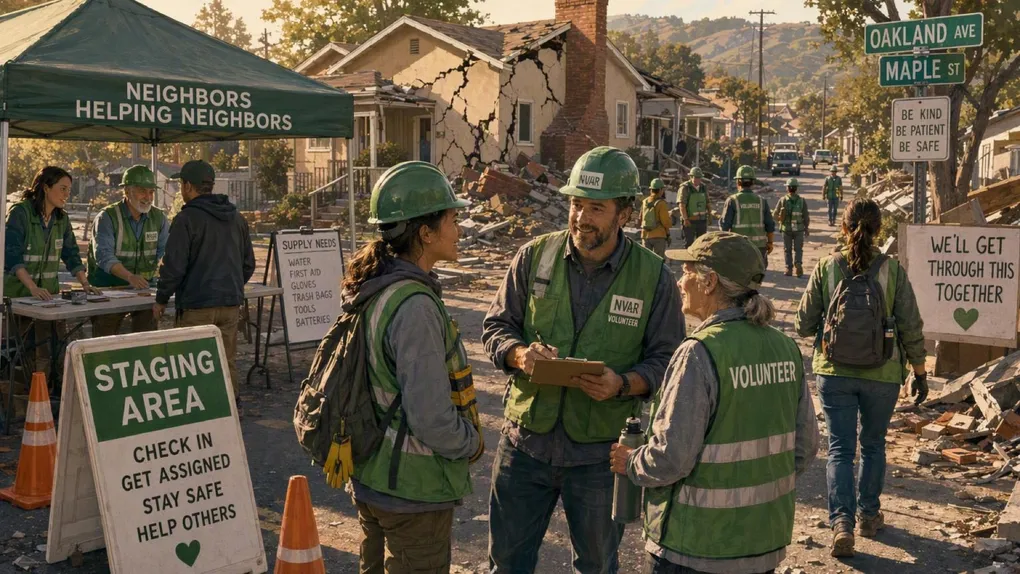
CERT: When Neighbors Are the First Responders
During the 1985 Mexico City earthquake that killed more than 10,000 people, untrained volunteers saved 700 lives, and 100 of those volunteers died doing it. That single statistic is why the Community Emergency Response Team program exists. The Los Angeles Fire Department studied the pattern, realized citizens are on their own during the early stages of every disaster, and built a training program in 1986 so the helpers would stop dying. FEMA expanded CERT nationwide in 1994 for all hazards. This series distills the nine units of the CERT Basic Training Participant Manual (2019) into posts you can act on.
Disclaimer: The information provided in this article is for general informational and educational purposes only. It is not intended as, and should not be considered, medical, legal, or professional advice. CERT skills require formal hands-on training. Contact your local emergency management office or visit Ready.gov/CERT to find a course.
The Readiness Audit
If professionals could not reach your neighborhood for three days, who would help?
- Green: You know your neighbors’ skills, your area has a CERT program, and you have trained or volunteered.
- Yellow: You would help spontaneously but have never trained for it.
- Red: You have no plan and no idea who on your street has medical or repair skills.
If you are Yellow or Red, execute Phase 1 immediately.
Phase 1: The Three-Day Problem
Goal: Understand why CERT exists.
Natural and manmade disasters severely restrict or overwhelm response resources, communications, transportation, and utilities, and damaged roads cut responders off from the worst-hit areas. For the initial period after a disaster, often up to three days or longer, individuals and neighborhoods may need to rely on their own resources for food, water, and shelter. The CERT manual’s math is simple: untrained helpers are spontaneous and well-intentioned, but their lack of training puts them at risk of injury or death, as Mexico City proved. Training converts that spontaneous energy into safe, effective response.
The Takeaway: The window CERT exists for is not the disaster, it is the gap between the disaster and the arrival of professional help. What you do today determines the quality of that window.
Phase 2: How CERT Teams Operate
Goal: Learn the deployment model.
CERTs identify meeting locations and staging areas before a disaster. The staging area is where the fire department and other services interact with CERTs, and a centralized contact point makes damage assessment communication and volunteer allocation work. In a real deployment, volunteers first assess their own needs and the priorities of their immediate environment. Volunteers without a need nearby report to staging, where the first volunteer to arrive becomes the initial Team Leader, passing leadership as more arrive. Volunteers in heavily impacted locations send runners to staging to request help. Acting as individuals first, then as team members, CERT volunteers can fan out through assigned areas, extinguish small fires, turn off natural gas at damaged homes, perform light search and rescue, and render basic medical treatment, all while acting as eyes and ears for uniformed responders.
The Takeaway: The staging area is the system. Individual initiative plus a central coordination point equals volunteers who help without becoming casualties.
Phase 3: What This Series Covers
Goal: Map the nine units to the posts ahead.
The CERT curriculum builds in sequence: disaster preparedness (Unit 1), organization and the Incident Command System (Unit 2), disaster medical operations in two parts (Units 3 and 4), disaster psychology (Unit 5), fire safety and utility controls (Unit 6), light search and rescue (Unit 7), and terrorism awareness (Unit 8), with Unit 9 wrapping the course in review and a simulation. This series follows that arc, one post per unit, plus a readiness checklist at the end that folds the course review into a printable form.
The Takeaway: Each post stands alone, but the skills compound in order. Preparedness first, organization second, then the hands-on skills.
The Essential Kit Checklist
- The Course: Your local CERT class located via Ready.gov/CERT or your emergency management office.
- The Staging Area: Your neighborhood’s pre-identified meeting location known to every household member.
- The Neighborhood Map: A working list of neighbors with medical, repair, or language skills.
- The Three-Day Baseline: Food, water, and shelter supplies sufficient for the first 72 hours.
- The Comms: Ham radio or similar backup communication identified for your area.
Scenario Planner (Contingencies)
“Professionals will get here fast, they always have.” The trap: past luck is not a plan. The manual is explicit that roads and communications may cut off areas for three days or longer. The fix: build your household and neighborhood plan assuming you are alone for 72 hours, then be pleasantly surprised.
“I would help, but I do not know what to do.” The trap: the Mexico City pattern, where untrained rescue attempts add casualties. The fix: this series is the map. Training converts good intentions into saved lives.
Next Steps
- Re-run the Readiness Audit. Scroll back to the top, answer the three questions honestly, and close whichever gap they reveal before you close this tab.
- Print the checklist. The kit list above only works if it exists when the power is out, so paper beats apps here.
- Fold it into the family plan. A prepared household beats prepared person, so put these steps in front of everyone who shares your roof.
Next: Read Disaster Preparedness the CERT Way for Unit 1’s home and workplace preparedness playbook.
Adapted from FEMA - CERT Basic Training (public domain). Read the original: CERT Basic Training Participant Manual (2019).