The Family Emergency Communication Plan
Cell networks fail in exactly the wrong pattern. They work right up until everyone in the county tries to use them at once, and then they drop calls, queue texts, and leave you refreshing a map that will not load. FEMA’s guide treats this as the central planning problem of any disaster, and its solution costs one page of paper and one household meeting. This post walks through building the Family Emergency Communication Plan the guide describes.
Disclaimer: The information provided in this article is for general informational and educational purposes only. It is not intended as, and should not be considered, legal or medical advice. Always follow the instructions of local authorities and emergency management officials.
The Readiness Audit
If your family were scattered when the cell network failed, could everyone reach each other?
- Green: Every family member carries a copy of the plan, an out-of-state contact exists with two ways to reach them, and the plan has been practiced.
- Yellow: You have everyone’s numbers in your phone, but no out-of-state contact and no paper copies.
- Red: Your plan is “we will figure it out.”
If you are Yellow or Red, execute Phase 1 immediately.
Phase 1: Build the Plan
Goal: Collect every contact and name the hub.
The first step is collecting contact information from the whole family into one communication plan, and the guide says to include more than relatives. Add medical facilities, doctors, schools, and service providers, because the numbers you need in a disaster are not always the ones you call on a normal Tuesday. The centerpiece is an out-of-state point of contact. When local lines are jammed, a relative two states away may be easier to reach than a relative two miles away, so everyone shares updates through that hub. The guide’s rule: have at least two forms of contact for that person, such as phone plus email.
The Takeaway: The out-of-state contact converts a coordination problem into a check-in problem. Everyone texts the hub, the hub broadcasts, and nobody needs a conference call the network cannot carry.
Phase 2: Add the Digital Layer
Goal: Use the tools that work when voice does not.
The guide recommends social media as a legitimate disaster channel, naming Facebook Safety Check and the American Red Cross Safe and Well as applications the whole family should sign up for in advance. These mark you safe or let family look you up after an event, and they run on data that may survive when voice networks do not.
The Takeaway: Digital check-in tools only work if the whole family has accounts before the disaster. Signing up during the event is too slow.
Phase 3: Distribute and Practice
Goal: Make the plan physical and rehearsed.
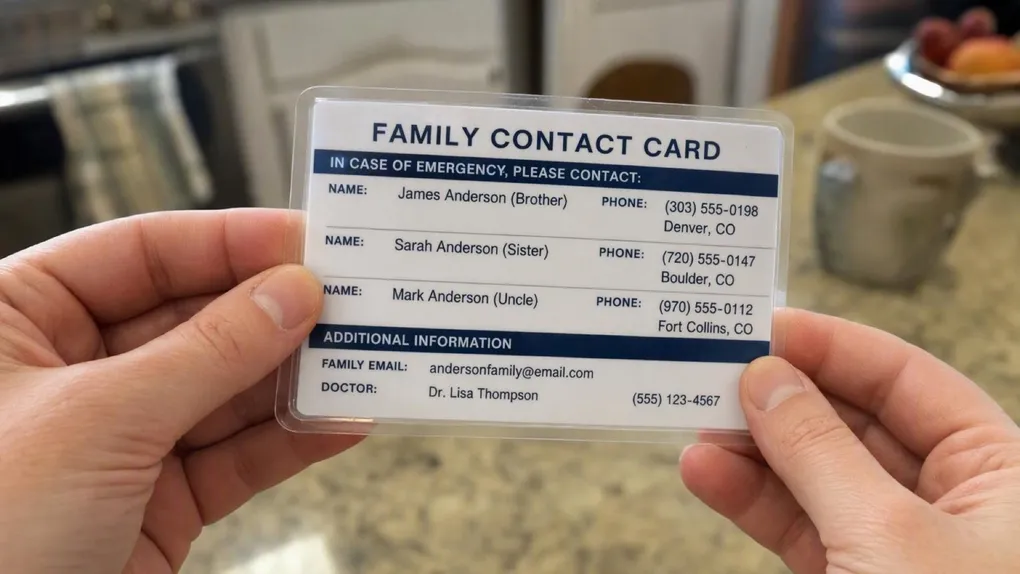
Everyone should understand the plan and carry a copy, either digital or as a wallet card. Post one in a central location at home, on the refrigerator or family bulletin board. FEMA publishes premade templates for wallet cards and large-print plans at Ready.gov. Then comes the step most families skip: the guide says it is vital to practice the plan once developed, just like a fire drill, and to hold regular household meetings to review the communication plan and the meeting place.
The Takeaway: A plan in a drawer is a rumor. Carried copies, a posted copy, and a practiced drill make it real, and the drill costs 15 minutes twice a year.
The Essential Kit Checklist
- The Contacts: Family, medical facilities, doctors, schools, and service providers collected in one plan.
- The Hub: An out-of-state contact named, with at least two forms of contact recorded.
- The Accounts: Facebook Safety Check and Red Cross Safe and Well set up for every family member.
- The Copies: Wallet cards for everyone, one copy posted centrally at home.
- The Drill: A calendar reminder for household plan practice, like a fire drill.
Scenario Planner (Contingencies)
“Our family group chat already does this.” The trap: a group chat depends on the same congested local network as everything else, and on everyone’s phone working. The fix: the out-of-state hub and the paper copies exist for the moment the group chat goes quiet. Keep both.
“The kids are at school and the school has its own plan.” The trap: assuming the school’s plan reaches you. The guide tells parents to confirm schools and daycare centers have emergency response plans, ask how they will communicate with guardians during a crisis, and whether they can shelter in place, evacuate, and reunite families. Ask the questions before the event, not during it.
Next Steps
- Re-run the Readiness Audit. Scroll back to the top, answer the three questions honestly, and close whichever gap they reveal before you close this tab.
- Print the checklist. The kit list above only works if it exists when the power is out, so paper beats apps here.
- Fold it into the family plan. A prepared household beats prepared person, so put these steps in front of everyone who shares your roof.
Next: Read Build Your Emergency Supply Kit and Document Vault to stock the supplies and paperwork the plan assumes you have.
Adapted from Federal Emergency Management Agency - Are You Ready? An In-Depth Guide to Citizen Preparedness (public domain). Read the original: Are You Ready? An In-Depth Guide to Citizen Preparedness.