Prepping for a physical health crisis checklist
The neighbor who found the retired teacher on her kitchen floor did not need to remember anything. She needed to follow a laminated sheet, and the sheet existed because one afternoon of planning had converted anxiety into four missions. Information is useless without action. When a physical health crisis strikes, your brain will be overloaded. This checklist converts anxiety into a series of manageable missions. Print it out and work through it, so you’re ready before the emergency arrives.
Disclaimer: The information provided in this article is for general informational and educational purposes only. It is not intended as, and should not be considered, medical advice. Always consult a qualified healthcare professional for your specific medical needs.
The Readiness Audit
- Green: Every mission below is checked and the sheet is printed.
- Yellow: You know most of it but nothing is written down.
- Red: You are reading this during an event. Start at Mission 1 and work in order.
Caution: The checklist only works if it exists when the power is out. Paper beats apps here, so print it today.
Mission 1: Establish your health baseline
Your goal: create a single, comprehensive document with all your vital health information.
- Create your personal health profile:
- List personal info: full name, date of birth, blood type.
- List medical team: names and phone numbers for your PCP, specialists, dentist, and pharmacy.
- List emergency contacts: at least two trusted people with their phone numbers.
- Create a medication list: drug name, dosage, frequency, and reason for taking.
- List allergies: medications, food, and environmental, with the specific reaction.
- List chronic conditions with the approximate date of diagnosis.
- Document significant medical history: surgeries, illnesses, and injuries with dates.
- Record key health metrics: blood pressure, heart rate, cholesterol, and A1c.
- Record vaccination history.
- Record health insurance details: company, policy number, group number.
- Gather your information:
- Schedule your annual physical and go prepared with questions.
- Log in to your patient portal to download lab results and medication lists.
- Formally request any historical medical records you need.
- Discuss your family health history with close relatives.
The Takeaway: One document, built from four sources, and it speaks for you when you cannot.
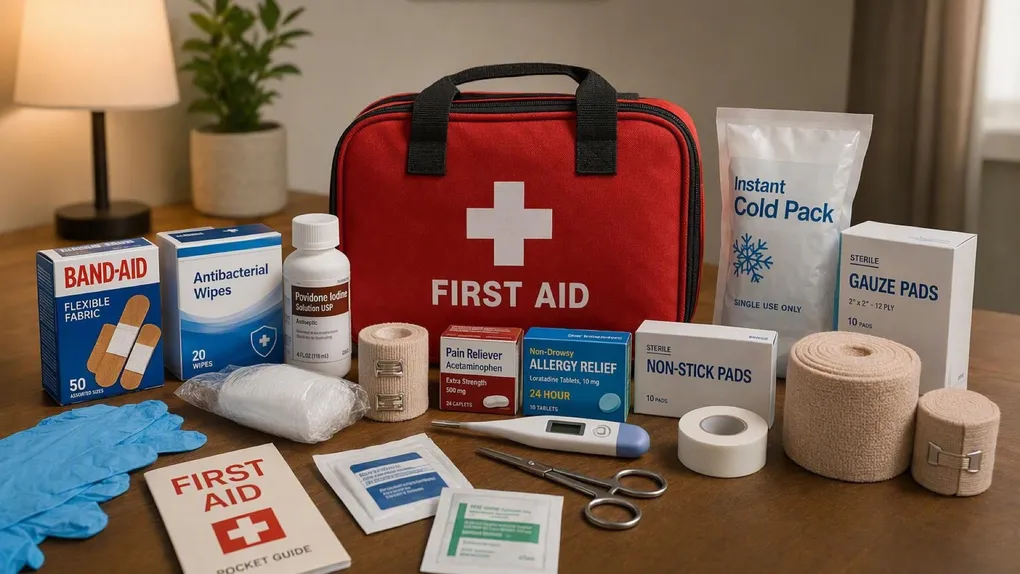
Mission 2: Build your home medical kit
Your goal: assemble a well-organized kit to handle common injuries and illnesses at home.
- Select a durable, organized container (tackle box or dedicated EMT bag).
- Stock wound and trauma supplies:
- Antiseptic wipes, saline wound wash.
- Gauze pads/rolls, abdominal (ABD) pads.
- Adhesive bandages (variety pack), butterfly closures.
- Medical tape, moleskin, burn dressings, trauma shears.
- Stock over-the-counter (OTC) medications:
- Pain/fever reducers (ibuprofen, acetaminophen).
- Allergy relief (diphenhydramine/Benadryl, loratadine/Claritin).
- Stomach/GI medications (loperamide/Imodium, antacids).
- Topical creams (hydrocortisone, antibiotic ointment).
- Stock tools and instruments:
- Fine-tipped tweezers, digital thermometer, nitrile gloves, CPR mask.
- Elastic (ACE) bandage, triangular bandage.
- A printed, up-to-date first-aid manual.
- Add personal and specialized items:
- A 30-day supply of all personal prescription medications.
- EpiPens, inhalers, or diabetic supplies as needed.
- Set a recurring 6-month reminder to check expiration dates and restock.
The Takeaway: Four modules, one audit cycle, and a kit that still works on the day you need it.
Mission 3: Learn lifesaving skills
Your goal: gain the confidence and competence to act effectively in a medical emergency.
- Enroll in a certified “first aid/CPR/AED” course (American Red Cross or American Heart Association).
- Learn to assess a scene for safety and a patient for responsiveness.
- Learn to treat the “Big Three” life threats: severe bleeding, choking, and sudden cardiac arrest.
- Learn to manage common injuries like burns, sprains, and fractures.
- Learn to recognize major medical events like stroke (F.A.S.T.), seizure, and severe allergic reaction.
- Download the official “First Aid: American Red Cross” app for quick reference.
- Set a calendar reminder to get recertified every two years.
The Takeaway: Skills are the only preps that weigh nothing and restart hearts.
Mission 4: Create your maintenance and communication plan
Your goal: build long-term health resilience and ensure you can get help in a crisis.
- Develop a health maintenance routine:
- Focus on a consistent, healthy diet and proper hydration.
- Incorporate regular movement (cardio, strength, and flexibility).
- Prioritize 7 to 9 hours of quality sleep per night.
- Regularly practice a stress management technique that works for you.
- Set up emergency communication methods:
- Wear a medical ID bracelet if you have a critical health condition.
- Set up the “Medical ID / In Case of Emergency (ICE)” feature on your smartphone.
- Create a “Vial of Life”, a copy of your health profile in a baggie in your fridge, with a sticker on your front door.
- Build your support network:
- Identify your Tier 1 (inner circle) and Tier 2 (local backup) support people.
- Have “the talk”: give your Tier 1 support a copy of your health profile and discuss your wishes.
- Provide your Tier 2 support with the contact info for your Tier 1 support.
The Takeaway: The biological shield and the lifeline are the same project: a body worth defending and a voice that defends it when yours is gone.
Scenario Planner (Contingencies)
“I don’t know where to start.” The trap: treating four missions as one giant project and never beginning. The fix: the fifteen-minute rule, tonight’s session covers only Mission 1’s first five boxes, and the rest gets its own evening.
“I finished the missions months ago.” The trap: treating the checklist as a one-time project. The fix: the annual re-run, medications change, kits expire, certifications lapse, so walk the whole sheet once a year on a fixed date.
Next Steps
- Print this page today and put it with the health profile, because the plan that exists only on a screen fails with the power.
- Work Mission 1 tonight: even the first five boxes produce a document that would change an ER intake conversation.
- Fold it into the family plan. A prepared household beats a prepared person, so put these steps in front of everyone who shares your roof. Start with Part 1: The body blueprint.
Originally adapted from public Red Cross and CDC health-preparedness guidance (public domain).