Prepping for an earthquake (Part 6): After the quake
The mother standing in her Christchurch driveway had one question and no way to ask it: were the kids’ schools okay? Every call failed. Every text sat unsent. The main quake was over, but the aftershocks kept coming for weeks, and the silence on the network was worse than the shaking. What she needed had never been installed: a person outside the disaster zone who answers the phone, and a family that knows to text instead of call. The earthquake damaged the buildings. The information blackout damaged the decisions.
The initial earthquake is often just the opening salvo. In the Christchurch earthquake sequence (NZ), significant aftershocks caused more damage and trauma than the initial tremor. Furthermore, modern disasters are defined by “Information Blackouts.” Cell towers jam immediately, leaving you isolated and anxious.
Caution: Silence fuels panic. If you cannot reach your family, you might make rash decisions - like driving into a danger zone to find them. If you ignore the risk of aftershocks, you might re-enter a compromised building just as it collapses. By establishing a communication protocol before the grid jams and understanding the science of aftershocks, you maintain tactical control. You know how to signal for help, how to connect with loved ones without clogging the network, and when it is safe to go back inside. This is Part 6 of the earthquake series.
Disclaimer: The information provided in this article is for general informational and educational purposes only. It is not intended as, and should not be considered, professional or emergency-response advice. Always follow the instructions of local authorities.
The Readiness Audit
If cell service went down right now, how would you tell your family you are safe?
- Green: You have a designated “Out-of-Area” contact (like an aunt in another state) that everyone knows to text. You have a battery-operated radio.
- Yellow: You have your spouse’s number memorized, but you plan to just keep calling until it goes through.
- Red: You rely entirely on group chats and have no backup plan if the internet fails.
If you are Yellow or Red, memorize Phase 2 immediately.
Phase 1: The Tsunami Rule (The 10-Minute Warning)
Goal: Survive the secondary wave.
If you live near the coast, the earthquake IS the warning.
- The rule: if the shaking is strong enough to knock you down or lasts longer than 20 seconds, assume a tsunami is generated.
- The action: do not wait for a siren. Sirens can fail. Move to high ground or inland immediately.
- The trap: do not go to the beach to “watch the water recede.” That is the precursor to the surge.
The Takeaway: On the coast, long or violent shaking is the siren, and the crowd walking down to watch the water disappear is walking the wrong direction.
Phase 2: The Comms Protocol (Text, Don’t Talk)
Goal: Connect when the network is overloaded.
1. The Bandwidth Reality
- The problem: after a disaster, everyone tries to make a voice call simultaneously. The network crashes.
- The fix: text messages (SMS). Data packets for text are tiny. They can squeeze through congested networks and will “queue” until a signal is found.
- The rule: “Text First, Talk Later.” Keep it brief: “I am safe. At home. Gas off. Love you.”
2. The “Out-of-Area” Contact
- The problem: local calls (within the disaster zone) often fail because local towers are dead or jammed.
- The fix: it is often easier to call out of the region than across it.
- The setup: designate one family member who lives in a different state.
- The protocol: everyone in your family calls/texts that one person. They act as the central hub, relaying safety status to everyone else.
The Takeaway: Tiny texts queue and squeeze through, and one relative outside the zone becomes the family’s switchboard when every local line is jammed.
Phase 3: The Aftershock Strategy (Structure Safety)
Goal: Don’t become a casualty of the second wave.
1. The “Fragile Building” Theory
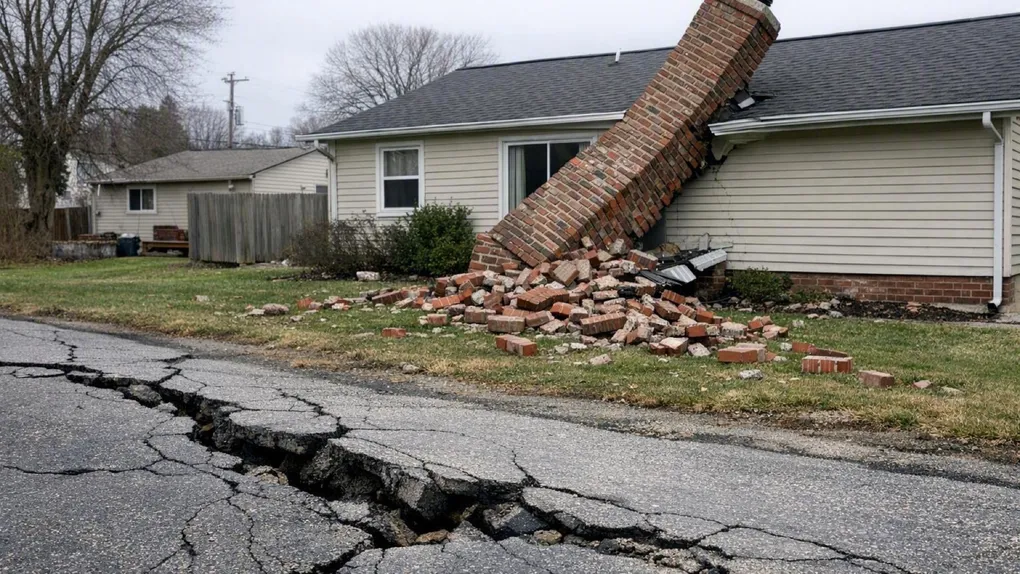
- The reality: the main quake may have cracked the structural supports of your home. It is standing, but fragile. A moderate aftershock (which can happen minutes or days later) can finish the job.
- The inspection: before staying inside, do a rapid visual check:
- Chimney: look at the roof line. Is the chimney separated or leaning? (Falling bricks are a major killer).
- Foundation: is the house shifting off the concrete?
- Smell: do you smell gas?
2. The Re-Entry Rule
- Action: if you have any doubt about structural integrity, set up camp in the backyard or garage (if safe). Do not sleep in a compromised house during the first night of heavy aftershocks.
The Takeaway: The standing house is not automatically a safe house, so the roof line, the foundation line, and the nose get a vote before bedtime.
Phase 4: Information Gathering (The Analog Link)
Goal: Get intel when the internet is down.
1. The NOAA Weather Radio
- Why: this is not just for weather. It broadcasts civil emergency messages. It works when cell towers have no power.
- The AM/FM backup: local news stations often switch to battery generators to broadcast vital info. Know the frequency of your local emergency station.
2. The “Analog” Internet
- The action: if the internet is down, information travels by word of mouth. Talk to neighbors. Share what you know. Community is the ultimate backup grid.
The Takeaway: When the digital grid dies, the broadcast band and the sidewalk take over, so know your radio frequency and know your neighbors.
The Essential Kit Checklist
- The contact: a written list of the out-of-area contact’s number, memorized by every family member.
- The radio: a battery-operated or hand-crank NOAA weather radio.
- The charger: a solar or hand-crank phone charger.
- The message: a pre-agreed phrase everyone uses to signal “I’m safe.”
Scenario Planner (Contingencies)
“I can’t reach my kids’ school and I’m panicking.” The trap: driving into the disaster zone on rumor and fear. The fix: the hub protocol, text the out-of-area contact with your status and wait. Everyone else in the family is feeding the same hub, and the first confirmed report is worth more than ten speculative car trips into jammed roads.
“The house looks fine but my neighbor’s cracked.” The trap: trusting your own optimistic read of a stressed structure. The fix: the first-night rule, if any structure on your street shows damage, aftershocks get the benefit of the doubt. Camp outside or in the car. The house can be inspected in daylight.
Next Steps
- Name the out-of-area contact tonight and tell them. A hub that does not know it is the hub is just a phone number.
- Set the family text template: “I am safe. At [place]. Gas [on/off]. Love you.” Memorized, not saved in a phone.
- Read the Earthquake Survival Checklist next, the one-page working document that compresses all six parts into a printable season protocol.
Originally adapted from public FEMA, USGS, and Red Cross earthquake guidance (public domain).