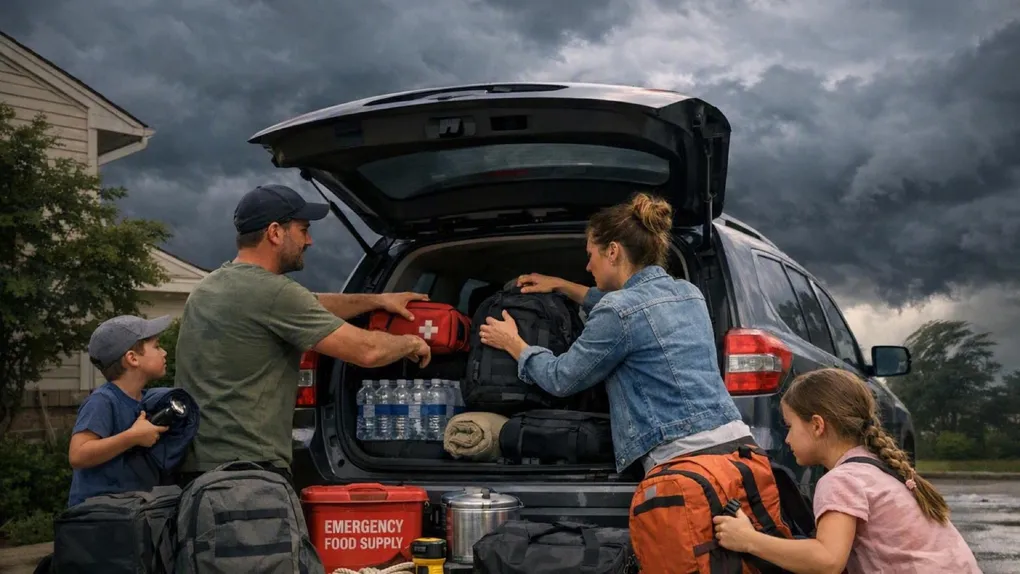
Prepping for a hurricane (Part 5): Run or hide
The evacuation debate in every coastal household comes down to one sentence that is almost never spoken out loud: what would make you actually leave? Most people have no answer until the water is moving. The families that navigate hurricanes well answered it years ago, on paper, and their answer usually has three lines: water, building type, and medical power.
This is Part 5 of the hurricane series, the decision part. The storm gives you two survivable strategies, and the wrong combination of them, leaving too late or sheltering where water can reach, is how people die in storms they were warned about for a week. Emergency services stop running when winds hit 45 mph. If the water rises after that, no one is coming for you.
Disclaimer: The information provided in this article is for general informational and educational purposes only. It is not intended as, and should not be considered, professional or emergency-response advice. Always follow the instructions of local authorities.
The Readiness Audit
Do you have a red line for leaving?
- Green: You know your flood zone (A, B, C), you have a destination 50 miles inland picked out, and your go-bags are packed.
- Yellow: You plan to leave “if it looks bad,” but you have not booked a hotel or called relatives yet.
- Red: You live in a mobile home or on the coast and plan to ride it out because you have a generator.
If you are Yellow or Red, read Phase 1 immediately.
Phase 1: The Decision Matrix (When to Run)
Goal: Identify the triggers that make evacuation mandatory.
Rule #1: Run from Water
Storm surge is the deadliest part of the hurricane.
- The trigger: if you live in an evacuation zone (surge zone) and authorities issue an order, you leave. No exceptions.
- The logic: emergency services stop running when winds hit 45 mph. If the water rises, no one is coming for you.
Rule #2: Mobile Homes Are Non-Negotiable
- The trigger: if you live in a manufactured home, trailer, or RV, you must evacuate for any hurricane, Cat 1 through 5.
- The logic: wind loads on these structures cause them to disintegrate or roll over. Straps fail. You cannot ride out a hurricane in a mobile home.
Rule #3: Special Needs
- The trigger: if someone in your home relies on electricity for medical needs (oxygen, dialysis, refrigerated meds), you evacuate.
- The logic: power will go out. A generator failing could be a death sentence. Go to a hospital or a shelter with backup power.
The Takeaway: Three red lines, none of them negotiable: surge zone, mobile home, medical power. If one is yours, the debate is already over.
Phase 2: The Evacuation Strategy (Go Tens, Not Hundreds)
Goal: Leave efficiently without getting stuck in the gridlock from hell.
The Destination Myth
- The trap: thinking you need to drive 500 miles to another state.
- The fix: go tens, not hundreds. You only need to get out of the surge zone and into a sturdy structure. Often, driving 20 to 50 miles inland to a hotel or a friend’s house on high ground is sufficient. This keeps you off the jammed interstates.
The Timing
- The trap: waiting until work releases you or the rain starts.
- The fix: leave on the watch. If you have kids, pets, or elderly family, leave before the mandatory order. Once the order is given, the roads become parking lots.
The Route
- Action: stick to the designated evacuation routes (marked with blue signs). These lanes are prioritized for flow, sometimes contraflow, where all lanes go outbound.
- Tech check: use paper maps. Cell towers along evacuation routes often jam due to millions of people trying to use navigation apps simultaneously.
The Takeaway: The evacuation that works is short and early. Fifty miles inland beats five hundred north, and the watch is the departure bell, not the warning.
Phase 3: The Shelter Strategy (When to Hide)
Goal: Survive the wind in a hardened bunker.
Rule #1: Hide from Wind
If you are not in a surge zone, not in a mobile home, and have a sturdy (stick-built or concrete) house, sheltering in place is often safer than being stuck in a car.
The Safe Room
- Location: identify a small, interior room on the lowest floor with no windows.
- Examples: a hallway, a closet under the stairs, or an interior bathroom.
- The bunker: drag a mattress into this room. Store your go-bags here. This is where you sleep during the storm.
The Last Resort Protection
- Action: if the roof fails or a window breaches, get into the bathtub. Pull the mattress over you to protect against falling debris and glass. This is the tornado protocol, and it applies to extreme hurricane winds too.
The Takeaway: Sheltering is a legitimate strategy for a sturdy house outside the surge zone, and its whole architecture is one windowless room with a mattress.
The Essential Kit Checklist
If evacuating:
- The 5 Ps: People, Prescriptions, Papers, Personal Needs, Priceless Items.
- The cash: small bills for gas and food when card readers fail.
- The snacks: food for the car ride (traffic could turn a 2-hour drive into 10 hours).
If sheltering:
- The water: 1 gallon per person per day stored.
- The bucket: for flushing the toilet.
- The light: headlamps for everyone (hands-free lighting is critical).
- The boots: sturdy shoes kept in the safe room.
Scenario Planner (Contingencies)
“I planned to stay, but the storm upgraded to a Cat 5 last minute.” The trap: changing the plan too late. The fix: the wind threshold. Do not get in your car if tropical-storm-force winds (39 mph plus) have already arrived. High-profile vehicles flip easily. If the winds are blowing, you are committed. Hunker down in your safe room. It is better to be in a damaged house than a tumbling car.
“I evacuated, but the storm turned and missed my house.” The trap: feeling like you wasted money on a hotel. The fix: the survivor’s mindset. You did not waste money, you bought an insurance policy that paid out in safety. Never regret a safety precaution that turned out to be unnecessary.
Next Steps
- Write your family’s red line tonight. Which of the three rules applies to your address, and what is your destination? One sentence, taped where everyone sees it.
- Pick and call your tens-not-hundreds destination now. A room at a relative’s or a hotel 30 miles inland, booked on a blue-sky day, is worth more than a plan made during the cone.
- Read Part 6: Surviving the storm next, for the hours inside the storm itself: the safe room, the eye, and the protocols that keep a sheltering household intact.
Originally adapted from public FEMA and National Hurricane Center evacuation guidance (public domain).